

China Best Perforated Aluminum Sheet Supplier?
Choosing China’s best perforated aluminum sheet supplier requires more than comparing prices. Buyers must examine alloy control, hole accuracy, coating durability, packaging, and export experience. A bright 5052 panel may look excellent under warehouse lighting, yet fail after coastal installation if surface protection is inadequate.
The International Aluminium Institute reported global primary aluminium production of approximately 72.8 million tonnes in 2023. That scale confirms aluminium’s industrial importance, but it does not guarantee consistent perforated products. Grand View Research also identifies growing demand for perforated metal in architecture, filtration, acoustic control, and industrial equipment. These applications require different open-area ratios, thicknesses, patterns, and tolerances.
“Perforated metal is a balance between material performance and functional design,” says Dr. John E. Hatch, a recognized aluminium industry author and consultant. His observation is useful here. A supplier should not recommend a standard pattern before understanding airflow, load, noise, corrosion, and installation conditions.
Details matter.
A dependable China supplier should provide mill certificates, alloy verification, dimensional inspection records, sample approval, and coating test results. Ask for actual data, not attractive photographs. Check whether the supplier controls punching, leveling, finishing, and packing in-house. These steps reduce inconsistent holes, scratched faces, and warped sheets.
Still, no supplier comparison is perfect. Published market data often combines several perforated metal categories, so it may not represent every perforated aluminum sheet application. Buyers should validate samples under real conditions. The strongest supplier is not always the cheapest. It is the manufacturer that documents performance, admits limitations, and delivers repeatable quality.
What Is a Perforated Aluminum Sheet?
China Best Perforated Aluminum Sheet Supplier?
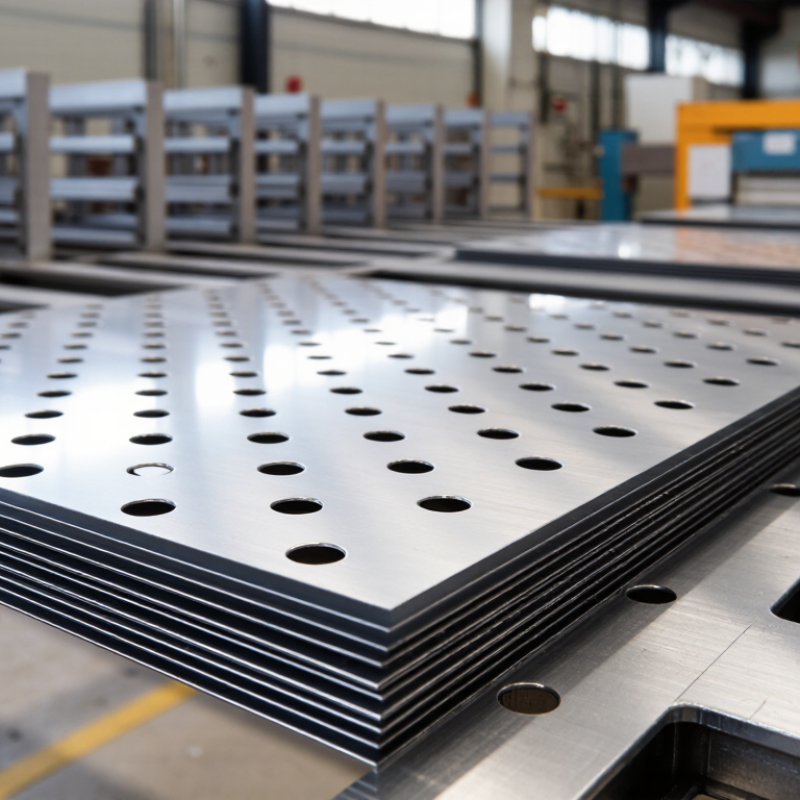
A perforated aluminum sheet is a flat panel with regularly arranged holes. Manufacturers create these openings through punching, drilling, or laser cutting. Hole shapes may be round, square, slotted, or decorative. The pattern controls airflow, light transmission, weight, and appearance.
It is not simply a thin metal screen. Sheet thickness, alloy, temper, hole diameter, pitch, and open area must work together. For example, a 10-millimeter hole with a 15-millimeter pitch creates a very different panel from a 5-millimeter hole on the same pitch. Fabricators commonly calculate open area before cutting. Small errors can affect noise control, ventilation, and structural stiffness.
The U.S. Geological Survey reported about 70 million metric tons of global primary aluminum production in 2023. This scale supports aluminum’s broad use in construction, transport, and industrial products. The Aluminum Association also states that nearly 75% of all aluminum ever produced remains in use. That supports long service-life expectations, but it does not guarantee every perforated sheet will perform well.
Quality depends on traceable material certificates, consistent hole spacing, and controlled flatness. ASTM B209 is often referenced for aluminum sheet specifications. In practical inspections, burrs and uneven edges still appear, even when drawings look correct. That detail deserves attention. A reliable supplier should provide samples, inspection records, alloy information, and measurable tolerances before mass production.
| Data Dimension | Key Information | Practical Selection Guidance |
|---|---|---|
| Definition | A perforated aluminum sheet is a flat aluminum panel manufactured with regularly arranged holes using a punching, stamping, or CNC perforating process. | Specify the material grade, sheet size, thickness, hole shape, hole size, pitch, pattern, and open area percentage. |
| Primary Material | Aluminum is lightweight, naturally corrosion-resistant, electrically conductive, and easy to form and fabricate. | Choose aluminum when low weight, ventilation, visual screening, or corrosion resistance is important. |
| Common Aluminum Alloys | 1050 and 1060 are commonly selected for high formability and conductivity; 3003 offers good formability with higher strength; 5052 provides higher strength and good resistance to marine and atmospheric corrosion. | Use softer grades for forming and decorative work, 3003 for general fabrication, and 5052 when greater strength or environmental resistance is required. |
| Typical Sheet Thickness | Perforated aluminum sheets are commonly produced in thicknesses from approximately 0.5 mm to 6 mm, although available ranges depend on the hole geometry and production equipment. | Thicker sheets generally provide greater rigidity, while thinner sheets reduce weight and may allow a higher open area. |
| Common Hole Shapes | Round, square, rectangular, slotted, hexagonal, and decorative custom shapes are widely used. | Round holes are versatile; square holes can provide a higher open area for some layouts; slots are useful for directional airflow and screening. |
| Round Hole Pattern | Round holes may be arranged in 60-degree staggered, 45-degree staggered, or straight-line patterns. | A 60-degree staggered layout is widely used because it provides efficient material distribution and a high open area. |
| Hole Diameter | Common round-hole diameters range from approximately 0.5 mm to 20 mm, with smaller or larger holes possible for specialized applications. | The hole diameter should be evaluated together with sheet thickness, pitch, required strength, and the risk of blockage. |
| Pitch | Pitch is the center-to-center distance between adjacent holes. It is normally specified in millimeters. | A smaller pitch increases the open area but can reduce the remaining material between holes and affect panel stiffness. |
| Open Area | Open area is the percentage of the sheet surface occupied by holes. It affects airflow, light transmission, acoustic performance, and panel weight. | For round holes in a 60-degree staggered pattern, open area is commonly calculated as: Open Area (%) = 90.7 × (d ÷ p)2, where d is hole diameter and p is pitch in the same units. |
| Square-Pattern Calculation | For round holes arranged in a square pattern, a commonly used calculation is: Open Area (%) = 78.5 × (d ÷ p)2. | Use the correct formula for the selected pattern and confirm the calculated value against the manufacturer’s technical drawing. |
| Standard Sheet Sizes | Common stock sheet sizes include 1000 × 2000 mm, 1220 × 2440 mm, and 1500 × 3000 mm, subject to local production and transport limitations. | Request cut-to-size panels when reducing installation joints, waste, or on-site fabrication is a priority. |
| Surface Finishes | Available finishes may include mill finish, anodized finish, powder coating, PVDF coating, brushing, and polishing. | Mill finish is suitable for basic fabrication; anodizing improves surface durability; powder coating and PVDF provide color options and additional weather resistance. |
| Edge Conditions | Perforated sheets may have a standard unperforated border, perforation-free margins, trimmed edges, folded edges, or reinforced perimeter frames. | Define the border width and edge treatment before production to ensure correct fastening and clean panel alignment. |
| Fabrication Options | Panels can be cut, bent, rolled, drilled, welded with suitable aluminum processes, or assembled with frames and fasteners. | Confirm the forming direction, minimum bend requirements, tolerances, and whether finishing will be applied before or after fabrication. |
| Acoustic Function | Perforated aluminum can act as a facing layer in acoustic panels. Sound absorption normally requires an air cavity and an absorptive backing material behind the perforated sheet. | The sheet alone is not a complete sound-absorption system; performance must be verified through a tested panel assembly. |
| Ventilation and Screening | Perforated sheets allow controlled passage of air and light while providing partial visual screening and physical protection. | Select the open area, hole size, and pattern according to airflow, privacy, safety, and maintenance requirements. |
| Typical Applications | Common uses include equipment guards, ventilation covers, ceiling panels, façade screens, balustrade infill, machine enclosures, acoustic panels, filters, and decorative interiors. | Match the alloy, thickness, finish, and edge design to the structural, environmental, and appearance requirements of the project. |
| Dimensional Tolerances | Actual tolerances depend on sheet thickness, hole size, pitch, panel dimensions, process capability, and applicable project specifications. | Include dimensional tolerances, flatness, hole-position accuracy, burr limits, and coating requirements in the technical specification. |
| Quality Inspection Points | Important checks include alloy and temper, thickness, sheet dimensions, hole diameter, pitch, open area, flatness, burrs, surface condition, coating thickness, and color consistency. | For repeat orders, approve a sample or first article before full production and retain inspection records. |
| Ordering Specification | A complete inquiry should state alloy, temper, thickness, sheet length and width, hole shape, hole size, pitch, pattern, open area, border, quantity, finish, and packaging requirements. | Clear specifications reduce quotation differences and help ensure that supplied panels meet the intended design. |
Related Posts
-
Best Perforated Metal Sheet Options for Global Buyers?
-
What Is Welded Wire Mesh Types Sizes and Uses?
-
Why Choose Welded Wire for Global Construction Projects?
-

Top 10 Benefits of Using Steel Grating for Your Projects?
-
How to Choose the Right Metal Mesh for Your Project?
-
Why Choose Metal Mesh for Industrial Applications?