How to Choose the Right Stair Nosings for Your Project?

Choosing the right stair nosings is a small design decision with major safety consequences. A worn school stairwell, a polished hotel entrance, and a damp factory staircase create very different risks. The best profile depends on traffic, lighting, footwear, moisture, stair geometry, and maintenance routines. There is no universal solution.

The World Health Organization reports that falls cause approximately 684,000 fatal injuries worldwide each year. Not every fall involves stairs, but the figure shows why edge visibility and secure footing deserve serious attention. Liberty Mutual’s 2024 Workplace Safety Index estimated that serious workplace injuries cost U.S. employers $58.5 billion in 2022. Stair-related incidents represent only part of that burden, yet they can interrupt operations, damage confidence, and create expensive claims.

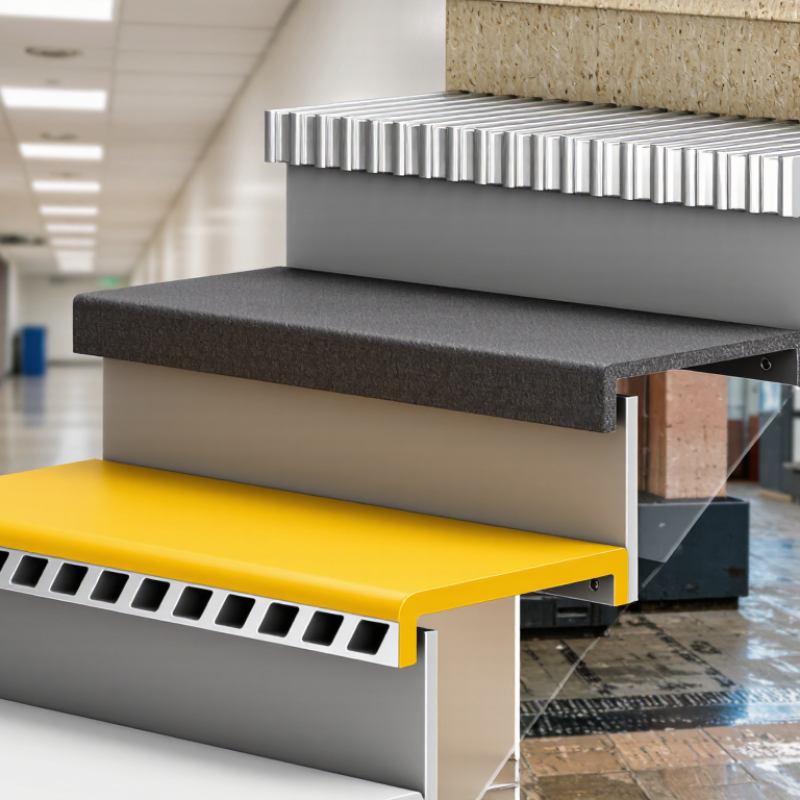
This guide examines how to compare stair nosings by material, projection, slip resistance, contrast, and installation method. Aluminum may suit heavy traffic, while rubber or PVC can improve comfort and reduce noise. However, surface texture can wear down. Bright contrast can also fade under sunlight or cleaning chemicals. Check the actual stair dimensions before ordering. Review applicable requirements, such as OSHA provisions, ANSI accessibility guidance, or relevant EN standards for your project location. Product brochures are useful, but independent test evidence is stronger. Ask for slip-resistance results, fire classifications, load information, and cleaning guidance. Small details matter. A nosing that looks excellent in a showroom may fail on a wet, poorly lit landing. That possibility deserves honest consideration.
How to Choose the Right Stair Nosings for Your Project?

Define Project Needs: Traffic, Stair Geometry, and 11-Inch Commercial Treads

How to Choose the Right Stair Nosings for Your Project?

Choosing stair nosings starts with real project conditions, not appearance alone. I have inspected busy commercial stairs where attractive profiles wore down quickly. Traffic levels matter. Schools, transit areas, and retail buildings need durable nosings with strong edge protection. Lower-traffic offices may require less aggressive specifications. Consider wet shoes, dirt, cleaning routines, and expected daily use.

Stair geometry also controls the decision. Measure tread depth, riser height, edge radius, and nosing projection carefully. An 11-inch commercial tread offers useful space, but the nosing must not reduce comfortable foot placement. Check whether the stair edge is square, rounded, damaged, or uneven. Small errors can create visible gaps. They can also weaken adhesion. I once underestimated an irregular concrete edge, and installation took longer than planned. The measurement seemed simple. It was not.

Tips: Create a full-size sample before ordering. Test the nosing on one typical step and one difficult step. Confirm its width, height, texture, and contrast under actual lighting. For heavy traffic, select a profile designed for repeated impact and routine cleaning. Avoid choosing a deep projection only because it looks substantial. It may interfere with the tread geometry. Review installation instructions with the installer, then record the final dimensions. This extra check can expose assumptions before they become expensive corrections.

Verify Codes: ¾–1¼-Inch Nosing Projections and 9½-Inch OSHA Treads

Choosing the right stair nosing begins with measurements, not appearance. A nosing may improve visibility and reduce slipping, but its projection must fit the applicable code. Many projects use a projection between ¾ and 1¼ inches. Measure from the riser face to the leading edge. Do not estimate from a product photo. Small differences can affect every step.

For OSHA-related industrial stairs, verify that each tread provides at least 9½ inches of usable depth where the rule applies. Local building codes may require different dimensions or additional details. Check the complete stair assembly, including riser height, tread consistency, edge contrast, and installation clearance. A drawing can look correct and still fail during field inspection. That mistake is expensive to correct.

Tips: Confirm the governing standard before ordering. Measure several existing steps, not only one. Choose a nosing that matches the tread material and expected traffic. Test visibility under actual lighting, especially near landings. Avoid creating a raised edge that catches footwear. I would also review the installation after fastening, because loose sections and uneven joints can undermine good design. Code language can be misunderstood, so have a qualified safety professional or building official review unusual conditions.

How to Choose the Right Stair Nosings for Your Project?

Verify Codes: ¾–1¼-Inch Nosing Projections and 9½-Inch OSHA Treads

The chart compares common dimensional requirements used when selecting stair nosings and designing stairways. The applicable building-code range for stair nosing projections is 0.75–1.25 inches, while OSHA requires a minimum stair tread depth of 9.5 inches for covered workplace stairways. Always confirm the requirements adopted by your local authority having jurisdiction.

References: International Building Code, Section 1011.5.5; OSHA 29 CFR 1910.25(c)(3). Values shown in inches.

Compare Materials: Aluminum, PVC, Rubber, and Slip-Resistant Surface Ratings

How to Choose the Right Stair Nosings for Your Project?

Stair safety starts with material choice, not appearance. The U.S. Consumer Product Safety Commission reports roughly one million stair-related injuries annually. That figure makes a small nosing detail worth serious attention. Aluminum suits busy commercial stairs because it resists impact, edge damage, and repeated cleaning. However, bare aluminum can become slippery when wet. It usually needs an abrasive insert or textured surface.

PVC is lightweight and cost-conscious. It can soften under heat and become brittle in cold conditions. Rubber offers quieter foot contact and strong wet traction, making it useful in schools, hospitals, and covered exterior areas. Its softer profile may wear faster under carts and heavy traffic. Abrasive mineral inserts often deliver higher slip resistance, but they can feel harsh under thin-soled shoes.

Check the test method before comparing numbers. ANSI A326.3 identifies 0.42 wet dynamic coefficient of friction as a benchmark for level interior surfaces, but stair applications need project-specific review. DIN 51130 uses R classifications, while AS 4586 evaluates pedestrian slip resistance under different conditions. These ratings are not interchangeable. A product marked R10 is not automatically safer on a wet staircase. The National Floor Safety Institute also stresses contamination control, because oil, dust, and water can defeat a good surface rating. Site testing matters. I would not trust a brochure alone. Measure the nosing under expected lighting, footwear, moisture, and cleaning conditions. Sometimes the most durable choice is not the most comfortable one.

How to Choose the Right Stair Nosings for Your Project? — Compare Materials: Aluminum, PVC, Rubber, and Slip-Resistant Surface Ratings

Material Typical Construction Best-Suited Applications Slip-Resistant Surface Options Typical Slip Rating Information Durability and Wear Resistance Moisture and Chemical Resistance Comfort and Noise Control Installation Considerations Key Limitations
Aluminum Extruded aluminum base with a visible tread insert or bonded abrasive strip. Commercial buildings, public facilities, schools, industrial sites, exterior steps, and high-traffic stairways. Grooved aluminum, serrated profiles, mineral-grit inserts, or replaceable abrasive inserts. R9–R13 may be achievable
The final class depends on the tread pattern and insert. R13 generally requires a highly profiled or abrasive surface and must be verified by testing.
Very high structural strength and excellent resistance to impact, deformation, and heavy foot traffic. Abrasive inserts can eventually wear and may be replaceable. Good resistance to rain, humidity, and many cleaning products. Avoid incompatible chemicals and galvanic contact with dissimilar metals. Hard and relatively noisy under hard footwear unless fitted with a rubber or elastomeric insert. Can be mechanically fixed or bonded. The substrate must be level, clean, and adequately supported; expansion and drainage may matter outdoors. Higher material cost than PVC. Bare aluminum can become slippery when contaminated, polished, or wet without a suitable tread insert.
PVC Rigid or semi-rigid PVC profile, often with molded ribs, a contrasting edge, or an integrated flexible insert. Indoor offices, residential buildings, retail areas, light commercial renovations, and carpeted or resilient-finished stairs. Molded ribs, textured vinyl, embossed grooves, or co-extruded flexible gripping zones. Often suitable for R9–R10 applications
Higher classifications may be available with specialized textured designs, but the exact product must be tested because PVC alone does not determine the rating.
Moderate durability. Suitable for normal pedestrian traffic, but more vulnerable than aluminum to deep impact, abrasion, and edge damage. Good resistance to water and common household cleaners. Prolonged exposure to solvents, oils, extreme heat, or strong chemicals can cause deterioration. Softer and quieter than metal. Provides moderate underfoot comfort, especially when combined with a flexible insert. Usually quick to install with adhesive or screws. Allow the profile to acclimatize where required and avoid bending below its recommended temperature range. Can discolor, embrittle, or deform under strong ultraviolet exposure, excessive heat, or heavy industrial traffic.
Rubber Solid rubber, molded elastomer, or rubber tread insert bonded to a metal or polymer carrier. Healthcare facilities, schools, residential buildings, wet-prone interiors, transit areas, and locations requiring quieter footfall. Fine ribs, wide grooves, patterned rubber tread, or embedded mineral particles. Commonly suitable for R9–R11 applications
Performance varies significantly with rubber compound, tread geometry, contamination, and test method. Wet-use claims should be supported by product test data.
Good impact absorption and abrasion resistance. Quality and formulation strongly affect service life; sharp objects and dragging loads may cause cuts or gouging. Generally good resistance to water and many cleaning agents. Oils, solvents, ozone, and certain chemicals can attack some rubber compounds. Excellent noise reduction, shock absorption, and underfoot comfort compared with rigid metal profiles. Typically bonded or mechanically fixed. The surface must be dry, smooth, and free from wax, grease, dust, and loose coatings. May shrink, swell, stain, or develop odor depending on formulation and environment. Some dark compounds can leave marks on light-colored flooring.
Aluminum with Abrasive Insert Rigid aluminum carrier combined with replaceable or bonded mineral-grit, silicon-carbide, or ceramic-grit tread. Exterior stairs, factories, loading areas, plant rooms, ramps, emergency exits, and areas with heavy contamination or demanding safety requirements. Coarse mineral grit, silicon carbide, ceramic aggregate, or profiled replacement strips. R11–R13 may be achievable
Coarse-grit and profiled systems can provide high slip resistance, but the rating is product-specific and must be confirmed under the applicable test standard.
Excellent resistance to heavy traffic and abrasion. The abrasive surface will gradually wear and may require insert replacement. Good outdoor performance when the aluminum alloy, adhesive, fasteners, and insert are suitable for the environment. Design drainage to prevent standing water. Hard underfoot and may generate noise. A resilient edge or backing can improve comfort and reduce vibration. Mechanical fixing is often preferred for demanding or exterior locations. Ensure the nosing is securely anchored and does not create a trip hazard. Can be uncomfortable in barefoot areas. Coarse surfaces may collect dirt and can be difficult to clean without reducing grip.

Rating note: R9–R13 classifications refer to the German DIN 51130 ramp test for footwear and contaminant conditions; they are not inherent ratings of aluminum, PVC, or rubber as raw materials. The actual result depends on the complete stair-nosing design, surface texture, contamination, installation, and testing conditions. Always request current product test documentation and check local accessibility, building, fire, and slip-resistance requirements before specifying a nosing.

Match Visibility and Safety: 2-Inch Contrast Strips and Rounded Edges

Choosing the right stair nosing starts with visibility, not appearance alone. A two-inch contrast strip helps define the tread edge for people using stairs in busy or dim areas. Strong contrast works best against the actual stair surface, such as a light strip on dark stone. Test samples under daylight, warm lighting, and shadows. Color can change more than expected.

Rounded edges also matter. A softly rounded profile can reduce sharp contact points and make the nosing more comfortable underfoot. However, excessive rounding may weaken the visual boundary. Keep the strip clear, consistent, and close to the front edge without extending dangerously beyond the tread. The nosing should sit firmly and flush with the walking surface. Small height differences can catch toes.

On site, I have seen attractive stair finishes fail because the strip disappeared under glare. That is an avoidable mistake. Another common issue is choosing a color that contrasts in a showroom but blends into the finished stair. Review the nosing after installation, not just from a product sample. Check wet conditions, cleaning residue, and evening lighting. Local accessibility and building requirements may also specify contrast, projection, edge shape, or slip resistance. Confirm those details with the project professional before ordering. Safety depends on the whole stair system, not one feature.

Select Installation and Maintenance: Adhesives, Fasteners, and Service Life

How to Choose the Right Stair Nosings for Your Project?

Select the installation method according to the stair substrate, traffic level, and site conditions. Concrete, timber, and metal each require different preparation. A dusty surface can weaken even a high-quality adhesive. Clean it thoroughly, then check that it is dry, level, and free from loose coatings. Moisture matters more than many installers expect. A simple moisture test can prevent early lifting.

Adhesive-only installation suits many indoor areas with stable temperatures and moderate traffic. Use a compatible construction adhesive, and apply it in controlled beads rather than random patches. Press the nosing firmly across its full length. Fasteners provide extra security on demanding stairs, especially outdoors or in commercial buildings. However, poorly placed screws may crack the nosing or create trip points. Use corrosion-resistant fasteners where moisture is present. Follow the fixing pattern recommended for the material.

Allow the adhesive to cure before opening the stairs to heavy use. It is tempting to rush this step. That mistake can shorten service life. Inspect edges, screw heads, and joint lines during routine cleaning. Remove grit before it acts like sandpaper underfoot. Replace damaged sections instead of covering them with another layer. In my experience, maintenance schedules often look perfect on paper but fail during busy periods. A shorter, realistic inspection routine may work better. Temperature changes, water, and abrasive footwear will eventually expose weak preparation.