How to Choose the Right Construction Banner?
Choosing the right Construction Banner is more than selecting a large sheet with bold lettering. It is a practical decision about visibility, durability, safety, and public trust. A banner placed beside a busy road must remain readable within seconds. One fixed to a temporary fence must survive wind, dust, rain, and repeated movement.
Construction signage consultant Laura Chen explains, “A good construction banner communicates clearly before people have time to wonder.” Her point is simple. The message, material, size, and installation method must work together. A premium design can still fail when thin vinyl tears at the corners. Bright colors can also lose impact when sunlight washes them out. Small details matter.
Start with the site conditions. Measure the viewing distance. Check whether vehicles, scaffolding, or trees block the sign. Consider mesh banners for windy locations, especially around open frameworks. Choose reinforced hems and metal grommets when the banner will hang outdoors for months. Use high-contrast lettering, generous spacing, and a short message.
There is no perfect banner.
A project manager may prefer a crowded design because every detail feels important. Viewers may remember nothing. That is a useful warning. Test the artwork from across the street, not only on a computer screen. Ask someone unfamiliar with the project what they noticed first. Their answer may expose a weakness.
This guide explores practical ways to compare materials, dimensions, artwork, mounting options, and expected service life. It also considers budget. The cheapest Construction Banner may become expensive after fading, tearing, or replacement. A reliable choice balances appearance, performance, and honest site requirements.
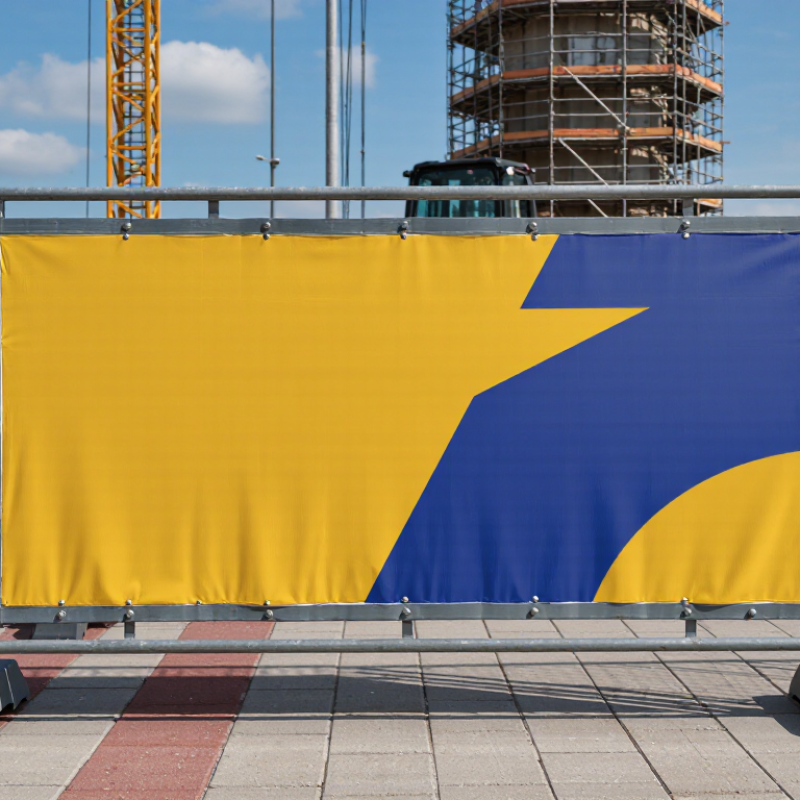
Define the Banner’s Purpose Under OSHA 29 CFR 1926.200 Sign Rules
How to Choose the Right Construction Banner?
Define the Banner’s Purpose Under OSHA 29 CFR 1926.200 Sign Rules
A construction banner should communicate one clear hazard or instruction. Under OSHA 29 CFR 1926.200, signs must remain visible while work is in progress. Select “Danger” for an immediate hazard, such as an unguarded excavation. Use “Caution” for a potential hazard, such as uneven walking surfaces. “Warning” may describe serious risks, but the message must stay specific and easy to understand.
This choice matters. The U.S. Bureau of Labor Statistics recorded 1,069 fatal work injuries in construction during 2022. That figure supports a practical lesson: banners cannot replace controls, barriers, training, or supervision. They must reinforce them. Use large lettering, strong contrast, and placement at eye level. Keep the message short. A banner reading “Open Trench—Keep Out” is stronger than a crowded paragraph. OSHA also requires traffic signs to follow applicable Manual on Uniform Traffic Control Devices guidance. Site conditions can change quickly. Recheck the banner after rain, dust, or equipment movement.
Tips: Walk the approach route before printing. Ask whether a worker can understand the message in three seconds. Match the signal word to the actual hazard. Avoid dramatic wording when the risk is ordinary. That mistake can weaken trust. Record the inspection date, but do not let paperwork replace a physical check. References: OSHA 29 CFR 1926.200; U.S. Bureau of Labor Statistics, Census of Fatal Occupational Injuries, 2022.
Calculate Wind Loads with ASCE 7-22’s qz = 0.00256KzKztKdV²
Choosing the right construction banner involves more than readable lettering. Wind resistance deserves equal attention. Under ASCE 7-22, calculate velocity pressure with qz = 0.00256KzKztKdV². This equation gives pressure in pounds per square foot when V uses miles per hour. The result changes with height, terrain, topography, and wind direction. A banner beside an open field may face stronger airflow than one between dense buildings. That difference is easy to overlook.
Use the project’s applicable basic wind speed from ASCE 7-22 criteria. Select Kz for the banner’s elevation and exposure category. Apply Kzt when hills, ridges, or escarpments accelerate airflow. Kd represents wind directionality. Do not guess these factors from a product page. A qualified design professional should verify them, especially near scaffolds, corners, and temporary fencing. Record every assumption. Small errors become expensive.
A 30-foot-high banner and a six-foot banner do not share the same Kz. Their edge effects can differ, too. After finding qz, calculate force using the effective area and applicable coefficients. Check hems, grommets, ropes, frames, and anchors as one system. Check every connection. Mesh fabric may reduce drag, but it does not automatically make an installation safe. Field inspections often reveal fabric pulling loose at one corner. The problem may begin with underestimated wind, weak attachment points, or an assumption nobody revisited.
Compare 8–13 oz Vinyl and Mesh Using ASTM D751 Performance Tests
Choosing a construction banner starts with the site, not the artwork. An 8–13 oz vinyl banner usually offers a dense, smooth surface for sharp text and strong color. It also blocks more light. Mesh vinyl uses small perforations to reduce wind pressure and allow partial visibility through the banner. That advantage matters on fences near walkways, equipment, or open corners.
ASTM D751 performance tests help compare materials with measurable evidence. Review breaking strength, tear resistance, and coating adhesion results. These values show how a banner may handle pulling, fastening, and repeated movement. Do not treat one number as a complete field prediction. A heavier 13 oz fabric can feel more durable, but poor grommet placement may still cause failure. I have seen strong material tear around crowded fasteners.
An 8 oz option may be easier to install and transport. It can suit short-term, sheltered applications. A 10 or 13 oz vinyl may better support longer displays, especially when wind exposure is moderate. Mesh can be the safer practical choice where wind movement is constant, though its perforations may soften small lettering. Test results also depend on specimen preparation and laboratory conditions. That detail is easy to overlook. Compare the same ASTM D751 method, direction, and reported units before choosing. Then inspect edge construction, reinforcement, and attachment spacing in the actual installation plan.
How to Choose the Right Construction Banner? - Compare 8–13 oz Vinyl and Mesh Using ASTM D751 Performance Tests
| Material Configuration | Nominal Weight
(oz/yd²) | Air Openness
(Approx.) | ASTM D751 Breaking Strength
(Typical Planning Range) | ASTM D751 Tear Strength
(Typical Planning Range) | Weather and Water Behavior | Best-Fit Construction Use |
| 8 oz coated vinyl, solid | 8 | 0% | 250–400 lbf/in | 35–60 lbf | Continuous coated surface; generally blocks rain and dust when seams and edges are properly finished. | Short- to medium-term fence banners, pedestrian messaging, and moderate-wind locations. |
| 10 oz coated vinyl, solid | 10 | 0% | 300–500 lbf/in | 45–75 lbf | Higher mass and coating stability than lighter vinyl; suitable for repeated outdoor exposure with appropriate UV protection. | General construction-site signs, branded project graphics, and medium-term perimeter fencing. |
| 13 oz coated vinyl, solid | 13 | 0% | 400–650 lbf/in | 60–100 lbf | Strong water resistance and good dimensional stability; creates the greatest wind load because it is nonporous. | Longer-term displays, rigidly supported hoarding, and locations where maximum opacity is required. |
| 8 oz PVC-coated mesh | 8 | 25–35% | 150–300 lbf/in | 25–50 lbf | Allows air and some light through; reduces wind pressure but does not provide a continuous waterproof barrier. | Open fencing, wind-exposed sites, and short-term graphics where airflow is more important than opacity. |
| 10 oz PVC-coated mesh | 10 | 30–40% | 200–400 lbf/in | 35–65 lbf | Good airflow and moderate tear resistance; rain can pass through the apertures, while the coating improves cleanability and UV durability. | Medium-term perimeter screens, scaffold graphics, and sites exposed to frequent wind. |
| 13 oz PVC-coated mesh | 13 | 35–45% | 250–450 lbf/in | 45–80 lbf | Heavier construction improves handling and service life, but the open structure still permits airflow and water passage. | Longer-term scaffold wraps, large-format wind-permeable graphics, and exposed elevated installations. |
| Selection guidance: Choose solid vinyl when water resistance, privacy, and maximum image density are priorities. Choose mesh when wind loading, airflow, and reduced sail effect are more important. ASTM D751 is a test-method standard for coated fabrics; it does not establish one universal pass/fail value. Actual results depend on yarn type, coating formulation, construction, sample direction, conditioning, seam design, and test procedure. The performance figures above are representative non-brand planning ranges and should be verified with project-specific laboratory reports. |
Size Lettering at 1 Inch per 10 Feet of Viewing Distance
How to Choose the Right Construction Banner?
Size Lettering at 1 Inch per 10 Feet of Viewing Distance
A construction banner must speak before workers or drivers reach it. A practical field rule is one inch of letter height for every ten feet of viewing distance. If people read the banner from 60 feet away, use lettering about six inches tall. This estimate comes from long-standing sign-legibility practice and aligns with visibility research discussed by the Sign Research Foundation. Its studies emphasize contrast, viewing time, and visual clutter as major factors in outdoor sign performance.
Do not measure distance alone. A dusty road, cloudy weather, fencing, and moving traffic can reduce readability. The Federal Highway Administration’s roadway-sign guidance also stresses clear typography, strong contrast, and adequate viewing time. White letters on a dark background usually create sharper separation. Avoid condensed fonts, thin strokes, and crowded contact details. A six-inch letter may work at 60 feet, but it can fail when equipment blocks half the banner. Real sites are less predictable than design screens.
Tips: Measure from the farthest realistic viewing point. Add extra letter height when traffic moves quickly. Keep the main message under seven words. Print a small proof, then stand at the site distance. If you squint, revise it. This simple test often reveals weak contrast or spacing problems that software misses. A useful rule is not a guarantee. Conditions deserve another look.
Specify Grommets, Hemming, and Anchoring for Safe Installation
How to Choose the Right Construction Banner?
A construction banner needs more than readable graphics. Its attachment system must withstand wind, vibration, dust, and repeated handling. OSHA recorded 1,069 construction fatalities in 2022, including 395 deaths from falls. That figure concerns broader site safety, but it reinforces one principle: temporary installations deserve careful planning.
Specify grommets by spacing, material, and reinforcement. Metal grommets should sit inside reinforced hems, not directly in unsupported vinyl. A practical field check is simple: pull each corner firmly before lifting the banner. If the fabric stretches around the hole, the reinforcement is too weak. Hemming also reduces edge flutter, which can enlarge holes over time. Do not assume thicker material solves every problem.
Anchoring must match the site’s exposure. ASCE 7-22 requires wind design to consider location, height, exposure, and building conditions. A banner beside an open road may experience stronger gusts than one behind a solid fence. Use rated ropes, straps, or clamps, and avoid sharp wire that can cut the hem. Leave modest tension, not drum-tight tension. Over-tightening is a common mistake. Weather forecasts should guide installation and removal decisions, especially before storms. A neat banner is not necessarily a safe banner.

