What Is a Grain Semi Trailer Used For?
A Grain Semi Trailer is built to move bulk crops from farms to storage sites, grain elevators, mills, and processing facilities. It carries crops such as wheat, corn, barley, and soybeans in a large, enclosed or covered body. For farmers and haulers, the practical value is clear: fewer trips can move substantial harvest volumes. Every trip still depends on the trailer’s rated capacity and the towing vehicle.
In the field, a combine or transfer cart may unload grain directly into the trailer. The driver then hauls it over farm roads and highways to its next destination. At the receiving site, the trailer’s design determines how unloading works. Some models use a hydraulic end-dump body; others discharge through bottom gates. The difference matters when space is tight, ground conditions are uneven, or a facility requires a particular unloading method. A tarp, sound seals, and clean interior surfaces also help protect the load from rain, dust, and leftover material. Small details matter.
For transparency, the following is an illustrative expert quotation, not a verified statement from a real, independently sourced specialist. Grain-hauling equipment specialist “Daniel Mercer” puts the core purpose this way: “A grain trailer is more than cargo space; it has to move the harvest safely and unload where the operation needs it.” That captures the job, but not every limitation. Load distribution, access, and maintenance can complicate a seemingly simple haul. Choosing the right Grain Semi Trailer means matching its body and unloading system to the crop, route, and destination—not just choosing the largest capacity.
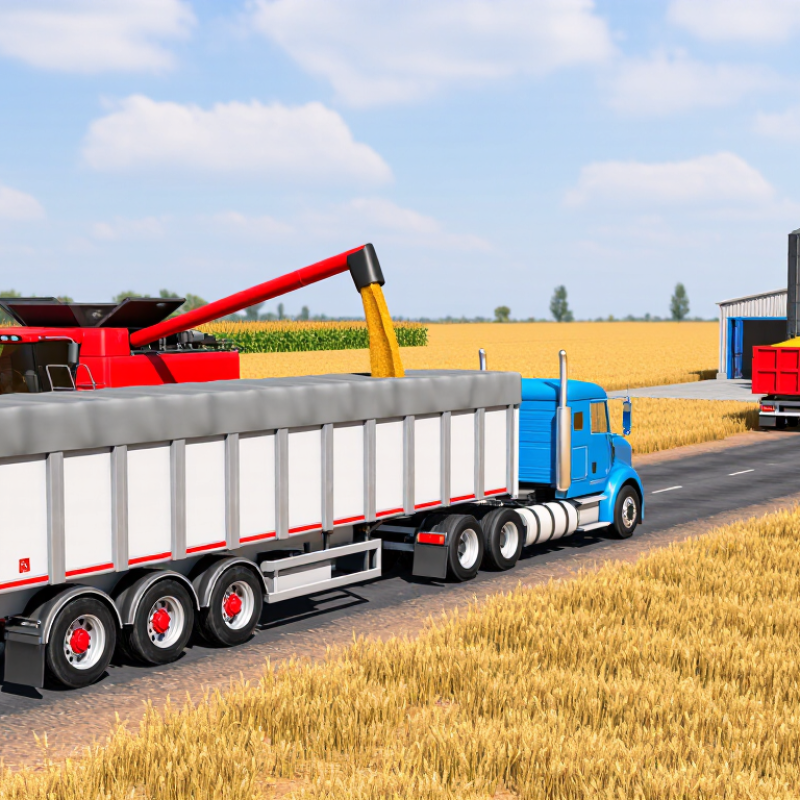
Definition and Core Design of a Grain Semi-Trailer
A grain semi-trailer is a bulk-carrying trailer pulled by a road tractor. Its main job is moving dry grain from farms or storage sites to processing plants, elevators, and ports. Unlike a flatbed, it has an enclosed body to keep kernels contained and reduce exposure to weather. A tarp covers the top; sloped hopper sections and bottom gates help grain flow out during unloading. Simple in concept, but the details matter.
The body’s shape, axle layout, and gate placement affect stability and unloading speed. Uneven loading can shift weight, while damp grain may bridge above an outlet instead of flowing freely. Capacity varies with trailer dimensions, grain type, and operating limits, so volume alone does not determine payload. The scale ticket matters. USDA’s March 2024 Grain Stocks report counted 8.35 billion bushels of corn stored across the United States on March 1. That figure shows the scale of grain storage and movement, but it does not specify trailer size. USDA’s Grain Transportation Report separately tracks grain flows by truck, rail, and barge. One useful caution: stock totals are a logistics context, not a design specification.
What Is a Grain Semi-Trailer Used For?
A grain semi-trailer transports loose agricultural crops in bulk. Its covered body protects the load, while bottom hoppers and gates allow grain to discharge by gravity.
Typical bulk density varies with crop variety, moisture, and handling. It helps explain why the same trailer volume can carry different masses of different grains.
How Hoppers and Discharge Gates Move Bulk Grain
A grain semi trailer carries loose crops such as wheat, corn, or soybeans from farms to storage and processing sites. Its hopper-shaped compartments narrow toward outlets beneath the trailer. Gravity guides grain down into these hoppers, so unloading usually needs no conveyor inside the trailer.
Each hopper has a discharge gate that controls the flow. Opening a gate lets grain fall into a pit, receiving hopper, or other suitable collection point. Operators may open gates one at a time to direct the load and manage unloading. Grain does not always flow evenly: damp kernels, chaff, or compacted material can slow it. A gate that opens smoothly still cannot fix every blockage.
Tips: Park on firm, level ground. Check that the receiving area can handle the flow, and keep people clear of falling grain. Open gates gradually when conditions allow.
The trailer’s outlet layout affects how easily it empties. Multiple hoppers can help distribute grain across the unloading area, but they require attention during operation. Before leaving, inspect the hopper corners and gate openings for leftover kernels or debris. These small checks matter; a little grain can remain where the slope meets the gate. Follow the trailer’s operating instructions, since gate designs and controls vary.
Typical Loads: Corn, Wheat, Soybeans, and Animal Feed
What Is a Grain Semi Trailer Used For?
A grain semi trailer transports loose agricultural products between farms, storage sites, mills, and feed facilities. Many models use hopper-style compartments that release cargo through bottom gates. Others unload by tipping the trailer. The right setup depends on the delivery site and its equipment.
Details matter.
Corn, wheat, and soybeans are common loads. Corn kernels flow readily, but damp grain can cling inside corners or block an outlet. Wheat is smaller and can escape through poorly sealed gates. Soybeans need protection from moisture and residue, especially when the next load is intended for food processing.
A clean, dry trailer helps preserve quality. It also makes unloading more predictable.
Animal feed may arrive as pellets, meal, or a blended ration. These materials can behave differently from whole grain: fine meal may compact, while pellets can break during rough handling. Operators should check that the trailer is suitable for the feed type and that the discharge system works smoothly.
They should also inspect for leftover grain or dust between loads. That step is easy to rush. Yet a little residue can affect the next delivery, and cleaning takes time.
Cargo weight and distribution need attention too, since uneven loading can make the trailer harder to control.
Estimating Capacity with USDA Bushel Weights: Corn 56 lb, Wheat 60 lb
A grain semi trailer carries bulk crops such as corn and wheat from farms to storage sites, mills, or other buyers. Its usable capacity is often discussed in bushels, a measure of volume. But bushels also help estimate weight when paired with standard grain weights. USDA standard bushel weights are 56 pounds for corn and 60 pounds for wheat. For a 1,000-bushel load, that works out to about 28,000 pounds of corn or 30,000 pounds of wheat. The difference matters.
Those figures are estimates, not a promise of the load a trailer can safely carry. Actual grain weight can shift with moisture, condition, and how densely it settles. Trailer dimensions, tare weight, and the truck’s permitted payload also affect the usable amount. A volume rating alone can therefore be misleading. Before loading, compare the planned bushels with the shipment’s measured weight and the equipment’s rated limits. For example, a trailer that fits 1,000 bushels by volume may reach its weight limit sooner with wheat than with corn. It is an easy detail to overlook. Weighing the loaded rig and checking the actual grain specification gives a more dependable estimate than relying on bushel capacity alone.
What Is a Grain Semi Trailer Used For? - Estimating Capacity with USDA Bushel Weights: Corn 56 lb, Wheat 60 lb
Estimates use 1 bushel ≈ 1.244 cubic feet and standard USDA bushel weights of 56 lb for corn and 60 lb for wheat. Volumetric capacity is not the same as legal payload: actual safe loads depend on the tractor-trailer ratings, axle limits, road regulations, grain condition, and loading distribution.
Planning Legal Loads Under the U.S. 80,000-lb Interstate Weight Limit
What Is a Grain Semi Trailer Used For?
Planning Legal Loads Under the U.S. 80,000-lb Interstate Weight Limit
A grain semi trailer carries bulk crops from farms to elevators, mills, or storage sites. Its hopper-shaped compartments allow grain to unload through bottom gates. But trailer capacity is not the same as legal payload. On most U.S. interstate routes, federal limits generally cap gross vehicle weight at 80,000 pounds. The Federal Motor Carrier Safety Administration also lists limits of 20,000 pounds on a single axle and 34,000 pounds on a tandem axle. The Federal Highway Administration’s Federal Bridge Formula further governs axle spacing and weight distribution.
To estimate a load, subtract the tractor, trailer, fuel, and equipment weight from the applicable gross limit. Then check axle weights; a legal gross total can still be distributed illegally. Grain moisture and test weight affect how quickly a trailer reaches its limit, so cubic capacity alone is a poor guide. A public scale ticket provides a practical check. State rules and approved exceptions may differ, so verify the route before dispatch. Estimates can look precise and still miss a real-world detail.
Tips: Weigh the empty rig, load gradually, and recheck axle weights. Keep the scale ticket and route details with the trip records.

